Sign in to ask, answer and view questions.







Thanks for joining me for part one of our discussion on social interaction.
Alright, let's talk about flirting.
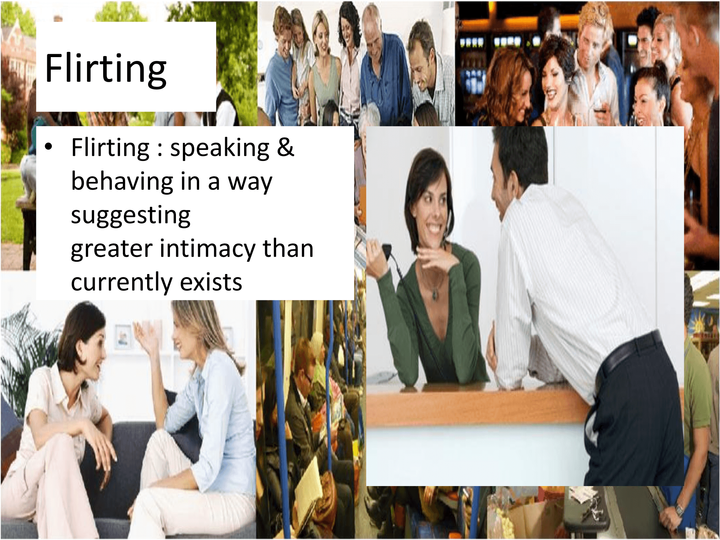
To be clear, so we know we're talking about the same thing, we're talking about the act of speaking and behaving in a way that suggests a greater intimacy from what currently exists.
When we flirt, we communicate playfulness, irony. It's a socially appropriate way to indicate interest in someone, but it also functions as a kind of social glue and social lubricant.
So, we may
act in a way that suggests greater intimacy than exists with
... the dry cleaner, the mailman... someone of that nature. We're not necessarily indicating interest. We're just using flirting as a lubricant that allows social interactions to go more smoothly, but also kind of a glue because it makes us feel more connected to someone. Anthropological research shows that flirting is found in some form in all cultures and societies across the world. So, it is in fact a cultural universal.
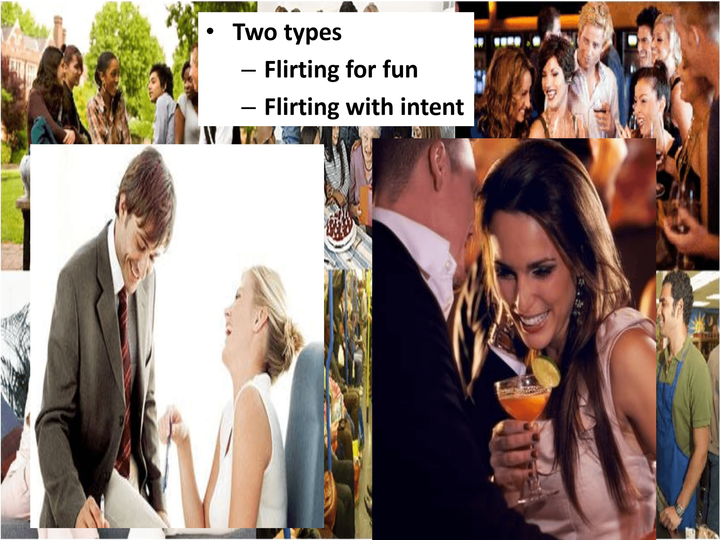
There are two types of flirting: flirting for fun and flirting with intent (an FWI, if you will). So flirting for fun: that can take place between friends and co-workers, or even total strangers. When you're flirting for fun, you're not indicating interest. You have no intention of leading up to any sort of romantic relationship or sexual encounter.
You are using your behavior as a social glue and social lubricant, and it increases the bonds between two folks.
When we flirt with intent,
we are in fact indicating interest in someone as a romantic partner or sexual mate.
When we flirt with intent,
the flirtER sends out signals of sexual availability to the flirtEE.
The flirtee may return that interest
and continue the flirting, or they may shut that an interest down. We can flirt through things that we say:
flattering comments, chatting someone up, exchanging numbers, but we also flirt through non-verbal signs: exchanging glances, hand touching, hair touching, etc.
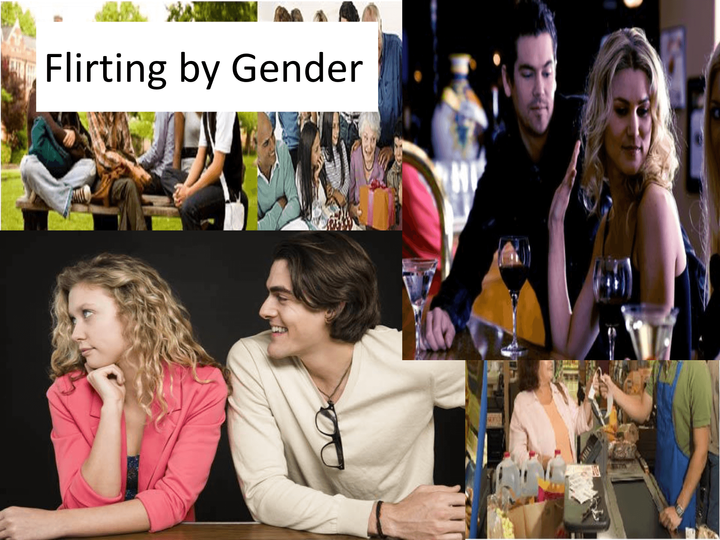
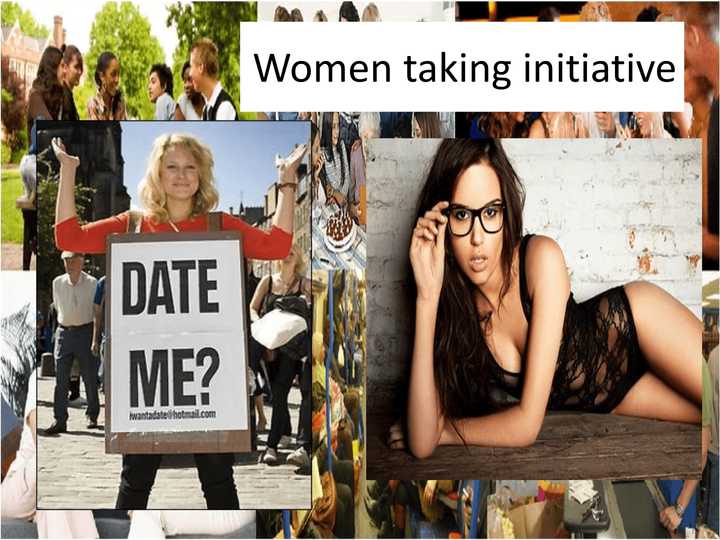
Flirting is in fact gendered. Researchers have found that 2/3 of flirtation sequences are actually initiated by women. Women use really subtle non verbal cues to initiate the courtship sequence. The funny thing is that these signals are so discreet that men are not necessarily consciously aware of them. For researchers who are observing these interactions and can see that they were initiated by women, when they interview the participants afterward, men typically believe they themselves made the first move.
Studies also show that men are not consciously aware of female seductive signals, but they do end up responding to them. So in these initiation sequences that are are brought about by women, men were not conscious of the fact that women had initiated them, but they responded to them.
What's also interesting is that men tend to mistake women's friendliness or sexual interest more often then vice versa.
Studies and experiments show that men perceive women who take the initiative in asking a man out as more sexually available,. To put it bluntly, if a woman ask a man out, the men believe that they have a better chance of the night ending in sex, or the date ending in sex, etc.
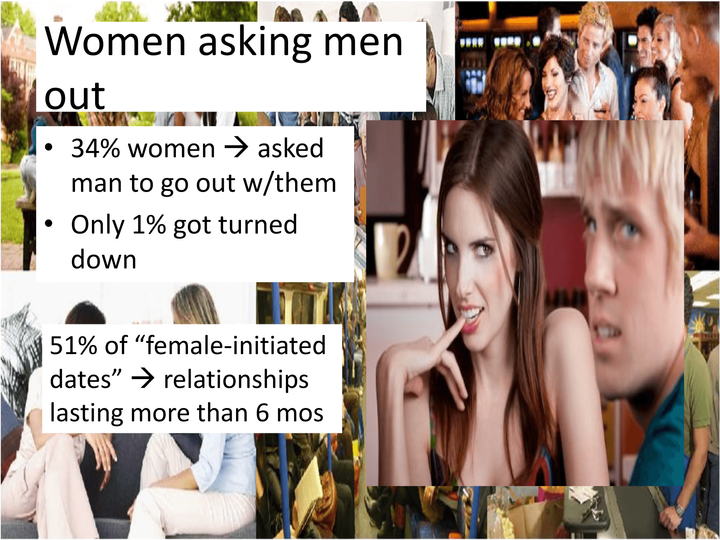
34% of women say that they have asked a man to go out with them, and only 1% of women got turned down. If we were together, we would have a discussion. I'd ask, "how many of you have asked a man out? How many men have been asked out by woman? How many said yes," etc.
And we might talk about why it is that women have such a low rejection rate, and typically what we'd come up with is that for women to ask a man out is typically seen as a gender transgression. You want to know later what a gender transgression is: basically means I'm acting in a way that is not considered traditional for my gender.
Examples of gender transcription might be maybe a man wearing a skirt, or a woman cursing, or something like that. So, behaviors that we don't typically ascribe to folks by their gender even though lots of folks participate in those behaviors. So, it may be that because it's a gender transgression, men think, "Well she must really be interested me to ask me out." Interestingly, 51% of female-initiated dates actually turned into relationships that lasted six months or more.
If we were together, we'd talk about possible reasons for that well.
And we could come back to the idea that it is a gender transgression. And so women are not indiscriminately asking a man out. For them to ask a man out, they must be really really interested, and that may account for the high rates of longer-term relationships because we don't see that with men asking women out.
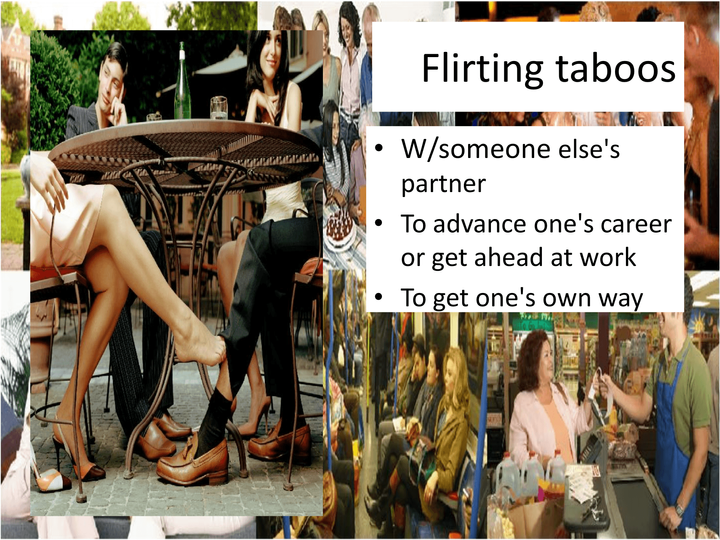
There are some flirting taboos. It's not okay when someone flirts with someone else's partner. We don't really like it when someone flirts to advance their career or get ahead at work, or when someone flirts to get their own way.
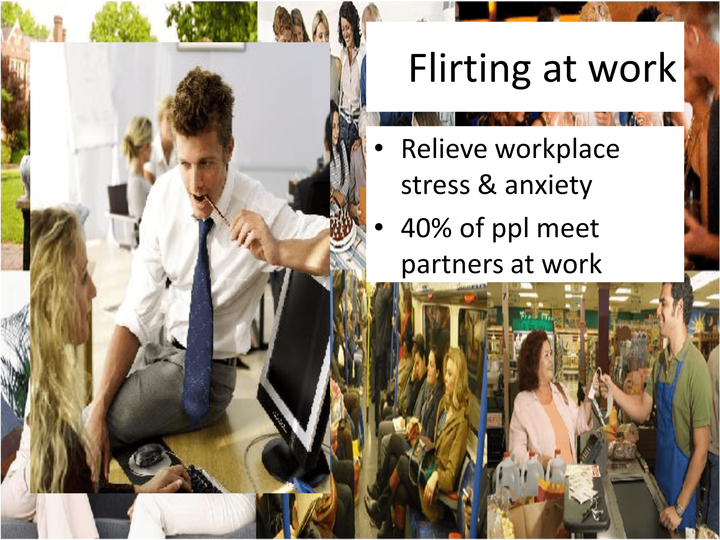
When folks do flirt at work, even just for fun, that social lubricant and glue... studies show that it actually can relieve workplace stress and anxiety. There is a fair amount of flirting with intention going on though because 40% of folks have met their spouse or their current sexual partners at work. And this is despite all the rules against fraterization to try to cut down on sexual harassment.
A kind of flirting for fun, we often call in the in the research charm as impression management, which is just a different way of saying flirting for fun. Research shows that when women employed charm as impression management--in other words, when they flirt for fun, not with inten--it helps women succeed in negotiations. A study showed that women who flirted for fun with car salesman got quoted prices that were 20% lower than men,
or the women who didn't flirt. So, just using that flirting for fun, that social lubricant, that social glue
helped women get lower prices on their cars.
Researchers theorize that feminine charm reduces the negative connotations of women playing hardball in negotiations. Because often when women try to play hardball, which is very frequently the technique that men used to negotiate, they're seen as difficult, etc. So,
charm or flirting for fun can be a technique that women can use to be more successful in negotiations.
However, women who flirt at work whether for fun or with intent are promoted less and make less money. What's the reason for that? Because they're seen as more feminine and therefore less confident. Just very unfortunate and something we'll talk about it more when we get to the unit on gender.
By contrast, using humor in the workplace has raised the status of male employees. And you're thinking, "Well, humor is different than flirting." It can be, but sometimes we use humor as part of our flirting for fun, and sometimes even as part of our flirting with intent. But using humor in the workplace raises the status of male employees, but has the opposite effect for women. And again, it reduces women's perceived effectiveness. Female humor was judged as more disruptive than male humor. Why might that be the case? Again, it comes back to that discussion of gender transgressions. For some reason, we don't expect women to be funny in the ways that we expect men to be funny.
Men are generally seen as rational and achievement-oriented and these aspects of the male stereotype reinforce the positive interpretation of humor. So says the researchers, who are experts on the topic. In contrast, working women are stereotyped as having lower dedication to work because of their association with family responsibilities. As a result of that, colleagues and supervisors are more inclined to view their use of humor in an negative light. They feel that it is signaling that women aren't taking work sufficiently seriously.
So, is flirting like it is in the movies?
And who gets flirted with? Well, it's probably not who you think it is. A researcher found that it's not actually the most physically appealing people who get approached the most often. It's the folks who signal their availability and confidence through basic learning techniques, like eye contact and smiles. So, if you want more flirting, you have to flirt more yourself.
Okay. So now I'm about to tell you the most effective ways to flirt according to science, according to research. Alrght, this is highly useful information. If we were together, I would encourage you to go out and use it, and report back to us. So, research says that there's really three
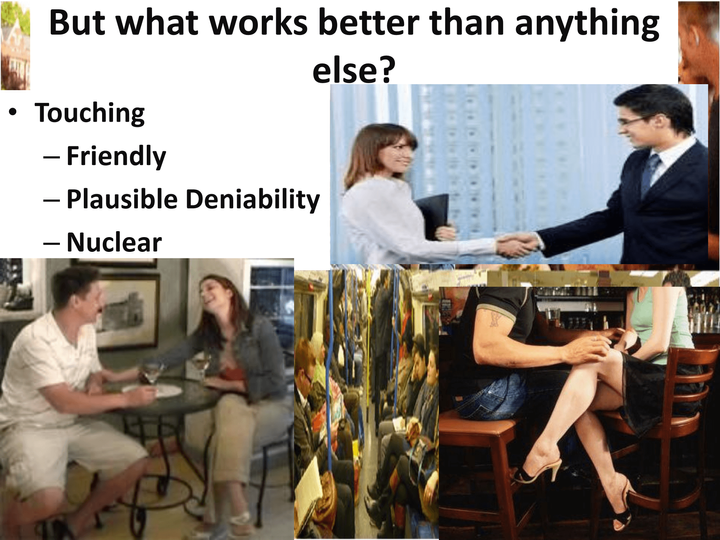
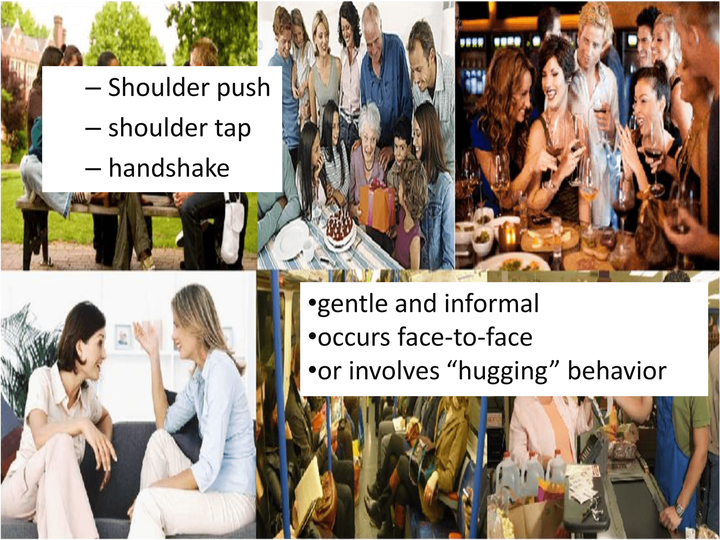
kinds of touching in terms of flirting. Flirting with touch works better than anything else. Okay, we have to be careful with the touching though. Friendly touching, and that's like a shoulder push, a shoulder tap, handshake for example. Then there's the touching that falls into the plausible deniability. Touch around the shoulder, waist or touch on the forearm. Now we say that's plausible deniability because you know, if you employ this and then somebody's like, oh I have my girlfriend. I have a boyfriend...You can say, oh, you know I'm not flirting with you, I'm just friendly. And then we have what we call the nuclear touch.
I want to be clear don't employee nuclear unless you know for sure that the interest is returned because you can't pull out of that. There's no plausible deniability for the nuclear touch. You touch someone on the face, you touch someone on the knee...that's a nuclear touching and you can't just pull the whole "I'm friendly" and try to get out of that. You're all the way in, you're completely committed and if it doesn't go well, there you are. Research showed that the most effective learning by touch behavior that the participants rated as reflecting the most flirtation was a soft face touch followed by touch around the shoulder or waist and a soft touch on the forearm. So notice they start with nuclear.
And then kind of work their way down. So again, I would say yes, this is absolutely the most flirtatious because you're starting with nuclear touch, but you can't you can't pull out of if that crashes and burns are going down with it again. I would employ that unless you knew for sure that the other person definitely returned your interest.
Lease for flirtatious touches where the shoulder push the shoulder tap in the handshake which again that's the friendly touching. So makes sense that that's at least four. But the touching that appears to convey the most relational intent is gentle and informal it happens face to face. I don't know how she would have someone or involve some kind of hugging Behavior.
Generally speaking the more formal the setting from our obvious. You need to be to get the signal across the study show that you're going to get a higher percentage of yes response. If you're flirting with someone and say a restaurant bar as opposed to flirting in the school hallway. Yes responses being the person is aware that you are flirting with them and it's because school is much more formal setting. So if you're trying to flirt with someone there has to be very obvious. If you're not restaurant bar, for example of kind of expect that if you're talking to them, you're probably interested. You're probably flirting.
So the research has a lot to say about what men can do to be successful with learning men who are successful to the following things. They directed more brief glances at the person. They were interested in brief Lance's, you know, don't hold a stair across the room. So that's kind of creepy engaged and a greater number of space maximization movements was that mean listening to body. So it takes up more space like putting your arm across the chair next to you stretching so both arms extend straight up in the air for the thing men do when they kind of
Pick up an entire doorway knows they put their arms up their kind of hanging onto the door frame or something. It's a space maximization movement. They change their location in the bar more frequently. Now, why is that well,
Evolution has caused us to you track Movement. We can't help it if somebody's moving or I goes to see what they're doing. You know, I like on your classroom and somebody gets up and do some shopping for pencil everyone kind of watches them go shopping a fence. All right, that's because so many changing their location. Someone's going to notice that they're moving around and be watching them.
Bills are just way greater amounts of non reciprocated touching to surrounding men like playfully shoving touching your elbow in the ribs of the men with them, but it only works if that's non reciprocated. Why is it kind of makes him seem like Alpha the group the researchers found that men who provides signals of their positive intentions examples through glancing behavior and their status through spacemax maximization and non reciprocated touching male peers receive more preferential attention from women.
If you're flirting, you're putting all all the moves out there letting somebody know and they're really they just don't seem to be getting the message at all. It's probably your fault. We are so afraid of being rejected by a potential partner. We often produce false read of situation example, we think that we're being are more obvious than we actually are.
And we may miss subtle cues from the other person that they are actually interested in us because we're so nervous.
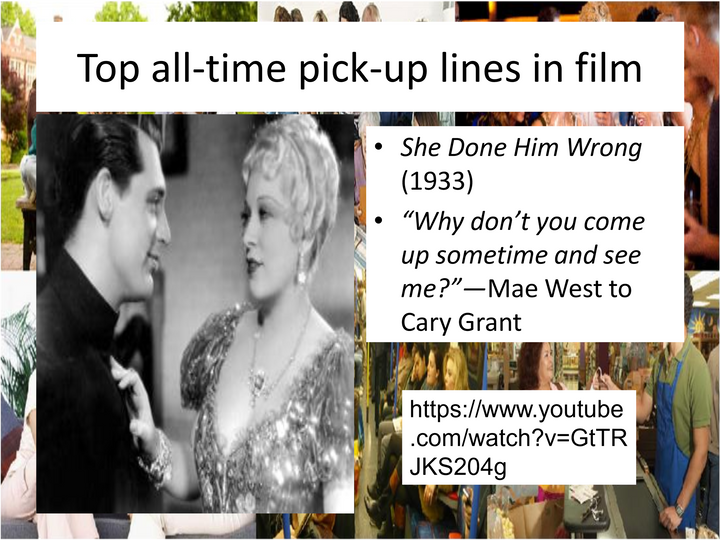
I'm sometimes it is. Absolutely what you say one of the top all-time pick up lines in a film voted on by a bunch of folks was from 1933 film called she done him wrong and have this little link here if you want to actually watch Mae West deliver this line Mae West's Cary Grant. Why don't you come up and see me sometime, in and of itself is that particularly flirting? No, but the way she delivers it makes all the difference when you actually watched a little clip of her delivering this line to Cary Grant. It seems pretty obvious. She's not asking him to come up and play Monopoly.
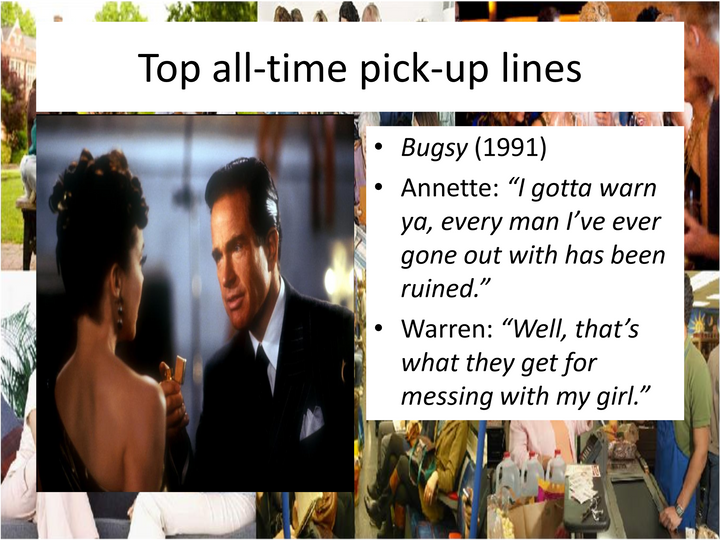
Another top all-time pick-up line has to do with Panther. So sometimes it's what you say. Sometimes it's how you say it and sometimes it's how you're talking to each other. So 1991 film Bugsy start Annette Bening and Warren Beatty who actually wanting to get married. So next character says I got to warn you every man I've ever gone out with has been ruined the word together. We have a discussion about okay. So what makes that so flirty. Well, she's kind of throwing down the gauntlet, isn't she? You know, I'm so I'm so amazing. I've ruined every man is effort has ever dated me. I'm not that that's a pretty big. She just feels really threw it out there. It's a very bold statement to make of course Warren's character just picked up the gauntlet answer right back to her and says, well, that's what they get for messing with my girl.
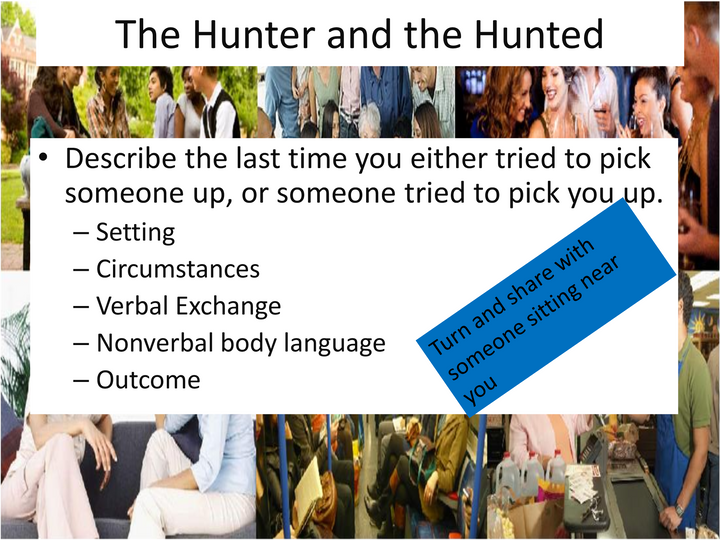
Okay, if you would on a piece of paper or file to turn in describe the last time you either trying to pick someone up or someone tried to pick you up tell me the setting the circumstances what was said or not said the non-verbal body language. And what was the outcome? Are you successful? Were they successful that says turn in share with someone you can't have to turn in a spot for you to share this with me.
Is it has never happened which I find hard to believe obviously you can just tell me that I will have this.
Wink poster for you. Watch this the big move and some fortunate. We're not together and we can't discuss this and why this is successful but no notification. You can watch it. It's a pretty brief clip.