Sign in to ask, answer and view questions.








Thanks for tuning in to part two of our discussion of theories and paradigms.
Right, so social theories are interested in explaining the behavior of social systems rather than the behavior of individuals and that's an important distinction that you want to make in your notes.
All theories, not just social theories, are imperfect, and they're imperfect because they simplify reality. Theories omit much and overemphasize much in order to come up with an overarching explanation for something. So, no theory is going to cover 100% of the instances of a phenomenon, so all theories are in fact imperfect.
Okay, so we're going to talk about
we're going to talk about a lot of stuff, but we're going to start by talking about the three founding fathers of sociology. And something important to realize when we're talking about them is most of them were really not writing for us, they were having conversations with other thinkers of their day.
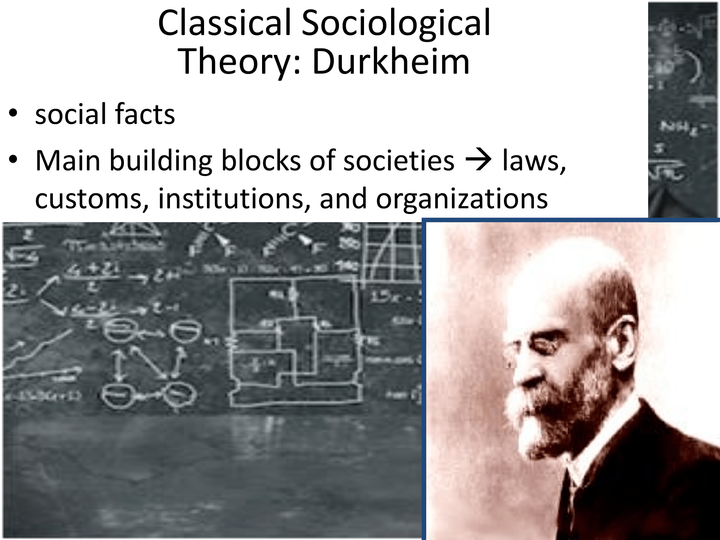
Alright, so we start with Durkheim. Durkheim came up with the idea of social facts. He also came up with the idea of the collective conscience that differs completely from the individual conscience.
He also studied the basis for social stability, which he believed was set of values shared by a society like morality and religion. So, in his opinion, that set of values conforms to the collective consciousness, and it's it's really the link to the cohesiveness that holds social order together. He believed that when we had that disappear, then society lacked that cohesiveness, and folks become extremely anxious and dissatisfied.
Next, we're going to talk about Marx. Marx mostly talked about the economy. The economy was a very big issue for Marx. He really believed that nothing else mattered beyond that. I shouldn't say nothing else mattered beyond that, but that until you understood what was going on with the economy, you couldn't really understand anything else. So that's why most of his writing is really about the economy and economic issues.
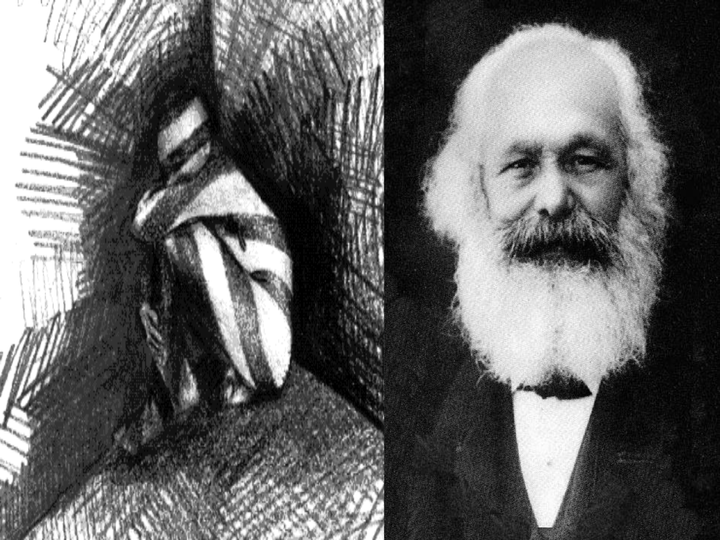
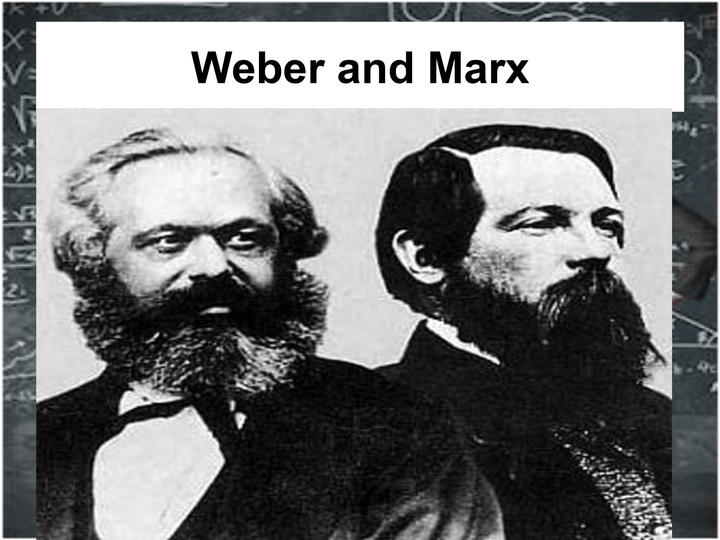
Alright, so there's a picture of Marx. He's an interesting looking cat! That beard! So Marx believed that societies
basically function according to economic forces in that society. His work really explained how capitalism shaped society. He explained that profit was produced through the exploitation of the working class.
And he considered the economic organization of society to be the most important influence on what humans think and how they believe. Marx is considered, next to Engels, one of the most influential thinkers of contemporary history. It's not just in sociology, but just history in general.
He really believed that most of what determined what went on in your life had to do with your relationship to class. In his mind, there was basically two classes: the bourgeoisie... if we're together I'd ask you to say that a few times, the bourgeoisie and the proletariat. The bourgeoisie where the people who owned the means of production. We'll talk about that in just a second, and the proletariat works for the bourgeoisie, and he believed that the working class should overthrow the existing class system, and we'll talk more about that in a second.
Okay, so a phrase you definitely want to know is "the means of production." And, as I said, Marx really believed that the basis of social order had to do with your relationship to the means of production. Now what is the means of production: It's all the things that you need to produce things. So like the factory, machines, the raw materials...and in his sytem, his view of it, not his system, his view of it, who owns the means of production. Do you remember? The bourgeoisie.
Okay, so,
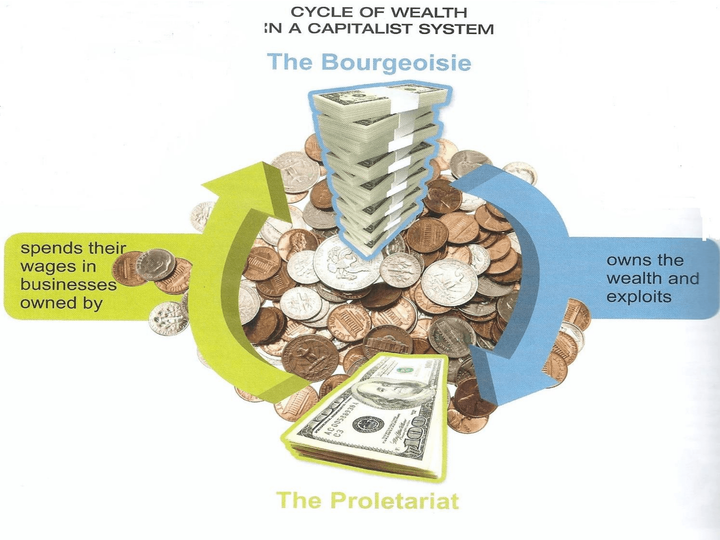
Marx explained it basically works like this: you have the bourgeoisie and they own the means of production and the wealth, and in order to make a profit, they have to exploit the proletariat or the worker. But the worker spends their wages in businesses that are owned by the bourgeoisie. So, it's like a self-feeding system and everyone needs everyone, but very often we forget that the bourgeoisie actually does need the proletariat. And we tend to sort of like glorify the bourgeoisie, and you can see that in today's world, you'll often hear different sorts of rhetoric being thrown around to that point, but actually that the system requires everyone's participation, and we'll talk about that more in a second.
Another big concept of Marx has to do with the structure of human society. You will see this again and people get very confused by this, and I'm going to try to make it not confusing as much as I possibly can.
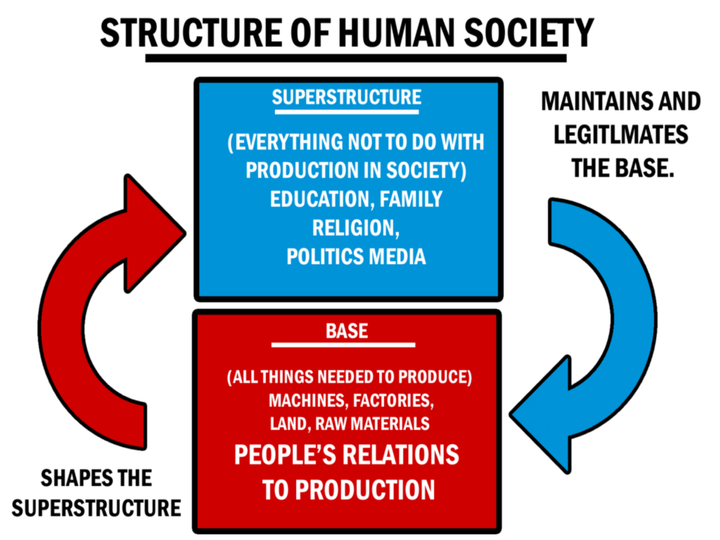
So Marx says you have the super structure
and the base, and the base is all the things that you need to produce items. So the machines, the factories, the land, and the raw materials. And that base shapes the super structure, and the super structure is everything that has nothing to do with production. So education, family, religion, politics, et cetera. But what does he mean by that? So, let me give you an example: think about some of the things you learned in school like K-12 before you got here. So, you learn things, like if you work hard you're rewarded and that what you get has to do with your merit and how much work you put in, and all that sort of thing. Those ideas are shaped by the base,
which is everything that has to do with producing things, right?
And so the base shapes the ideas in the superstructure that we are given and those ideas maintain and legitimate the base. We get the same sorts of ideas from education, family, religion, politics, media... All of these ideas that basically encourage us to continue in whatever our role is in
the means of production.
In our
role in terms of producing or not producing or whatever it is that we do in the economy. Okay, hopefully that makes sense, if it doesn't reach out to me.
Marx talks about the fact that struggle is the engine of progress. While we don't necessarily want that conflict, social conflict is in fact the core of historical progress. So, sometimes we get really distressed by social unrest, but the reality is
when we look through history, times of progress and change have come from that social unrest.
Marx explained that
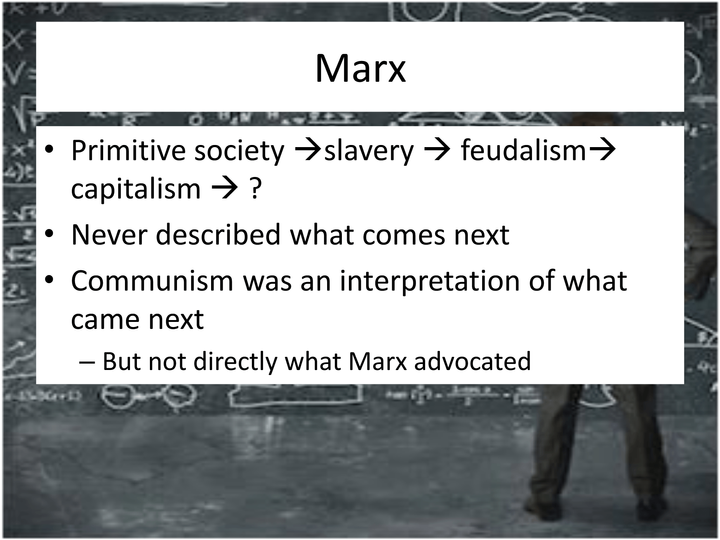
when you look at society from a historical standpoint, we sort of been progressing along, right? We have primitive society, like the hunter-gatherers, and then we evolve into slavery, and then we evolve into feudalism, and then capitalism, right? And he said that the trick is for us to not think that capitalism is the end of the road. That if we look historically, something must come after capitalism. And contrary to what a lot of folks think, it's not that he just thought capitalism was terrible. He agreed that capitalism was certainly better than feudalism and slavery, etc. But that something else had to be coming. We had to be evolving toward something else. The clincher is he never really describes exactly what comes next.
He's associated with Communism and he wrote The Communist Manifesto, obviously, but communism was an interpretation of what came next, but not directly what Marx advocated.
Okay, other
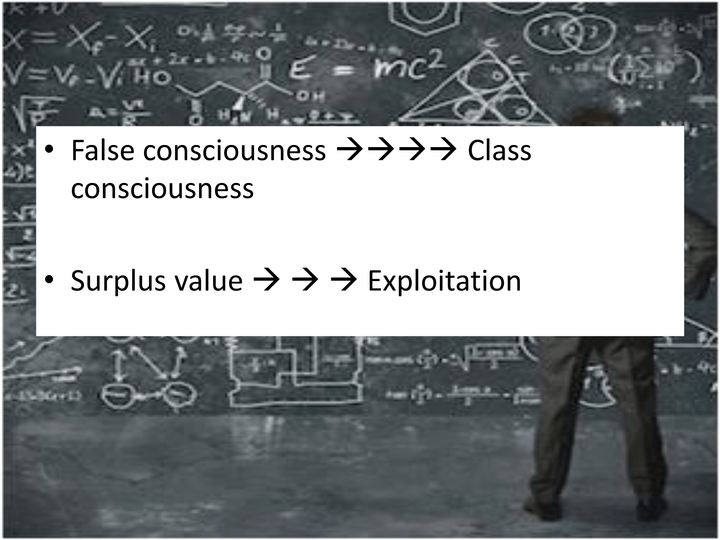
concepts you want to know. So, false consciousness happens when people without power accept an ideology that is contrary to the interests of that people as a class. We see this when the oppressed might support laws against their own interests, and even make sacrifices that actually benefit the bourgeoisie. There have been studies about folks who are getting food stamps themselves, but voting for politicians who are promising to cut food stamp benefits. That's an example of false consciousness.
Marx would say that the class in power imposes their ideology on the entire society in part through media. And that the false consciousness that most of us function in is going to exist until the exploited class develops a sense of class consciousness. Class Consciousness is a social condition where members of a social class in particular, the working class, are actively aware of themselves as a class. And that once that happens, people will unite in pursuit of their collective interest and challenge the class in power.
Marx said most workers really don't truly understand how capitalism enslaves them. And that's part of what allows false consciousness to persist.
Surplus value:
Marx explained that surplus value can only happen as a result of exploitation of workers.
Because surplus value, or profit as we call it now,
can only happen when the sale of goods produced by wage laborers far exceed the cost of making the materials. So, I can only make a profit if I can sell them something for more than what it cost me to pay my laborers and pay for the materials and the buildings and etc. etc. So, surplus value is by definition exploitation of the workers, according to Marx.
Marx also talked about alienation. One word: alienation, not Alien Nation. Alienation. And he explained that alienation occurs in four ways.
Number one, workers are alienated from the objects they produce because they don't own what they produce. Back,
previous to capitalism: say I make shoes. I own the leather and the thread and the needle and the
things that make the holes in the shoes. I own all of these things, right? And when I make a pair of shoes, I own the shoes that I'm about to sell. But in today's world, I don't if I work at a factory making shoes or whatever it is, I don't own any of the materials I'm working with, and when I'm finished making the shoes, I don't own the shoes.
Number two: Workers are alienated from the process of production. They're not working for their own needs, but for the capitalist. So, I'm making shoes. Yeah, I'm making shoes to feed myself, but it's also artistry right? When I'm making them and I own all the materials and all those sorts of things, right?
If I'm making them in a factory, that's not what's happening. It's just a job t
hat I go to every day because I have to feed myself. Yes, but I'm really working to create profit for the capitalist, the bourgeoisie.
Number three: Workers are alienated from themselves. They are not allowed to recognize their own potential because they perform the same task over and over on a daily basis. So, again back to the shoes. When I own all the materials and I'm making the shoes, I make the entire shoe, and when I'm done I have this sense of satisfaction. I just made this pair of shoes. If I'm working in a factory, I'm not making a whole pair of shoes. Maybe my job is to punch the holes down the left side, and your job's to punch holes down the right. I'm just doing one thing over and over and over. I'm not making an entire pair of shoes. Number four: Workers are alienated from their fellow workers. They're either physically isolated from other people who also work there, or they're in direct competition with your companions. If we both have a job punching holes in the shoes, and you're punching holes faster than I am, then you're making me look bad and you're jeopardizing my job. So, we're in competition with one another.
Alright. moving on to Weber. Weber is spelled W-e-b-e-r. It looks like Weber, but he's German so it is Veh-ber. If were together, I would say say Weber for me.
Okay. So Weber says, "hey, look here Marx: the economy is important, but society has three dimensions: the political, economic, and the cultural. And this may sound like yeah, duh, but at the time this is kind of a revolutionary idea. He also said if you want to understand social behavior, you have to understand the meaning that behavior has for the social actor. And again you're like, yeah, duh, but at the time this is a pretty new idea. He also felt that you can never capture the reality of society. So you should focus on ideal types. Now what is an ideal type? So an ideal type... So, if you think about a professor, what do you think of, when I say the word professor? What do you kind of imagine in your mind? You probably imagined kind of an older guy, maybe he has a pipe. He's got one of those jackets with patches on the elbows. He wears glasses that are dignified and knowledgeable, right?
So an ideal type is
all the things that something could be, but Weber says you're not going to find all of those things in one
person, one business, one whatever it is that you're looking at in the world.
So, we're really just looking at these ideal types, like all the things that something could be, or sort of the ideal of what something is. It's a little bit of a
complicated kind of a concept but it's very interesting.
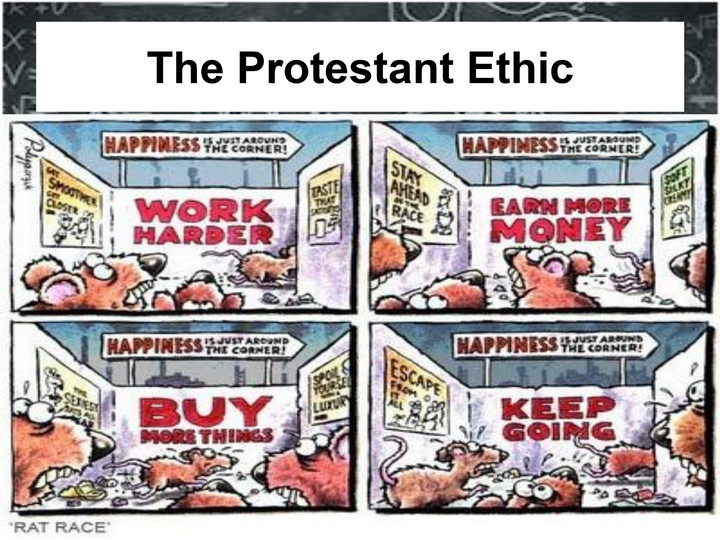
Weber wrote a book called "The Protestant Ethic and the Spirit of Capitalism." And it's one of his more famous works. Basically what he did, was he was trying to figure out what it was that was going on in the West that caused people to abandon their traditional religious values and orientation and encourage them to develop a desire for acquiring goods and wealth. In other words, what was going on in certain areas in the West that caused capitalism to really take hold and really take off! And what he found was a specific kind of Protestantism, that's why it's called the Protestant Ethic, called Calvinism and that Calvinism had a set of beliefs developed around the concept of predestination that really allow capitalism to take hold. Now what is predestination: It's the idea that certain things are determined, right? Fate, if you will. Well in Calvinism, it was believed that predestination had to do with whether or not you were to go to heaven. So they have this idea it was already determined when you were born who was going to heaven and who wasn't going to heaven.
They did not think that you could do good works or perform acts of faith to get there.
So, how did you go to heaven or not go to heaven? You were either among the elect in which case you were going to heaven or you were not. How do you know if you're one of the elect? They believe that wealth was a sign that you were one of God's elect; therefore, providing encouragement for people to acquire wealth. You see how that religious belief really encouraged capitalism, right?
It provided religious sanctions that fostered a spirit of men applying themselves to acquiring wealth. Now he's not saying that the Protestant ethic is the only cause of the rise of capitalism, but he did believe it was a powerful force in fostering its emergence.
He also had a concept called the iron cage. He said the Iron Cage is something that exists in modern society. We've all created this modern cage, but it traps us in systems that are supposed to make our lives easier, but actually just kind of create the sort of dehumanized society.
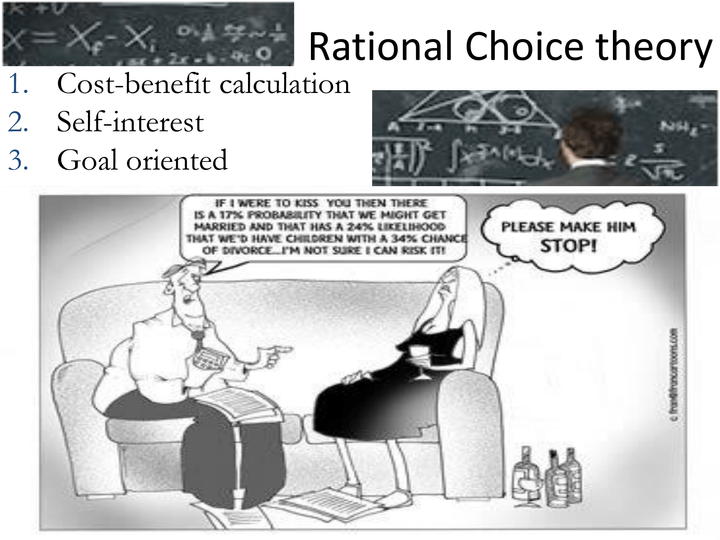
He's also responsible for Rational Choice Theory. Interesting thing about Weber is, he had lots of different ideas and lots of different sort of areas of interest. Now a lot of people really mess up Rational Choice Theory. I want to be clear, it has to have all three of these things. Sometimes people just see a cost-benefit analysis or self-interest and are like rational choice theory! Nope, doesn't work that way, it has to have all three things. It has to have a cost-benefit analysis. Okay. So that's like you make a pro-con list, for example, that's kind of a cost benefit analysis. I have to be acting in my own self-interest, and I must be goal-oriented. If all three of those things are there, then Rational Choice Theory would apply. If they're not, then it does not.
So, Weber also believed in alienation as documented by Marx, but he would say it doesn't have anything to do with the ownership of the means of production. It's a consequence of the bureaucracy and rationalization of social life that we've created this modern world where everything is supposed to be easier and more efficient, but it's actually alienated us from ourselves and from other people.
Again, just a reminder that most of these guys are talking to someone else and basically saying, like, you know what, I dig what you're saying. I dig your work, but you have missed some important things and let me tell you what they are.
So, this is an important lecture. There are lots of questions on the test that come from this lecture. So, you want to be sure that you understand it. Feel free to watch it more than once to be sure that you understood and that you have the notes that you'll need.