Sign in to ask, answer and view questions.








Thanks for joining me for a discussion of media and crime.
The average American spends about 40 hours a week watching television shows. I know what you're thinking: You're not spending that much time. No, you're probably not. College students don't have that kind of free time. But the average American spends that amount of time. And 70% of us see at least one movie every year in the theater.
In a previous lecture, we talked about the culture industry and how mass media, which is comprised of all the things you see there, make up the culture industry.
Just a refresher: the culture industry points out that popular culture is like a factory producing standardized cultural goods used to manipulate mass society into passivity. Because the consumption of the easy pleasures of pop Culture renders us docile and content, no matter how difficult our circumstances. But it also robs us of our imagination, takes over our thinking for us, and makes everything homogenized, so that whatever diversity remains is constituted of
small differences. We're all complicit in the culture industry. We play our role, if you will.
Studies have shown that we tend to seek out media that reinforces the views that we already have. We tend to avoid messages that conflict with our already held viewpoints. The predominant
influence
of media is to convince less powerful people that it's in their best interest to do what's actually in the most powerful people's best interest.
At least, so says the experts. They point out: this isn't coercion. You think that it's your own idea. You internalize these messages to the point that you don't even realize where these ideas come from. You think this is your own idea. This is just something you liked, not something you've been conditioned to like.
Since mass media portrayals are often aren't real, and you're watching fictional shows, we tend to think that they don't impact us. The big mythology about media is that it doesn't have any impact. Again, media both mirrors our desires, our attitudes, values, and beliefs, and informs, plants our desires, attitudes, values, and beliefs.
It's important to realize that even when we're watching something that's not fictional--so, the news for example--there's a social construction of the representation of crime. We tend to think of the news as: the news is just telling me what happened. It is what it is. It's just factual. But in
reality, the news is actually manufactured by a process of selection. That selection is determined by the criteria of what is newsworthy.
What they're going to show us and what they're not going to show us.
Through that process of deeming things newsworthy or not newsworthy, we are presented a very distorted picture of crime.
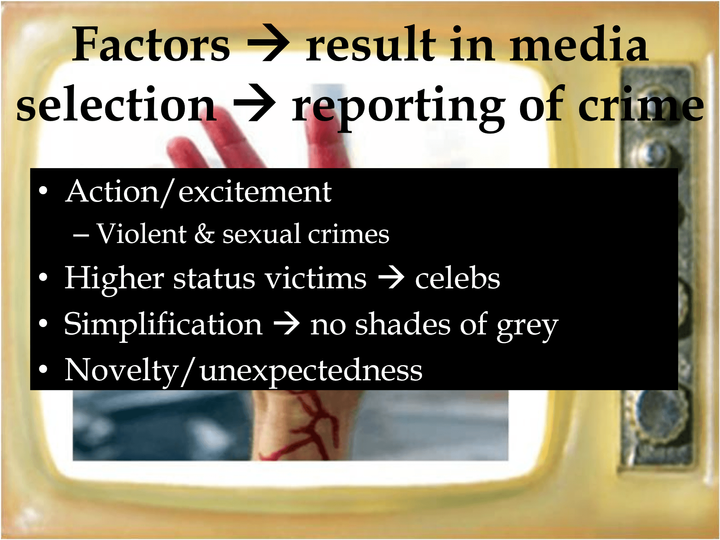
What causes a crime to be deemed newsworthy, and therefore reported on the news? If a crime has got a lot of excitement, action, a lot of violence, sexual crimes get reported, for example. Higher status victim like celebrities. And what they present to us tendd to be very simplified. They don't really present a lot of shades of grey. They sort of tell us how to feel about it through the headlines that they choose, the phrasing they choose to tell us the story, the images they choose to present to us. We're really told how to feel about what we're seeing. The news is more likely to include a story if it has some unexpected kind of angle about it. So, when you think about it, you think about the way the news is...
again, we can have this idea that the news is just telling me what happened, but then think about things that you know that have happened to people that never made the news. So, news isn't just everything that happens, right? It's selected to be reported on, and that's how it is socially constructed.
Media presentations of crime
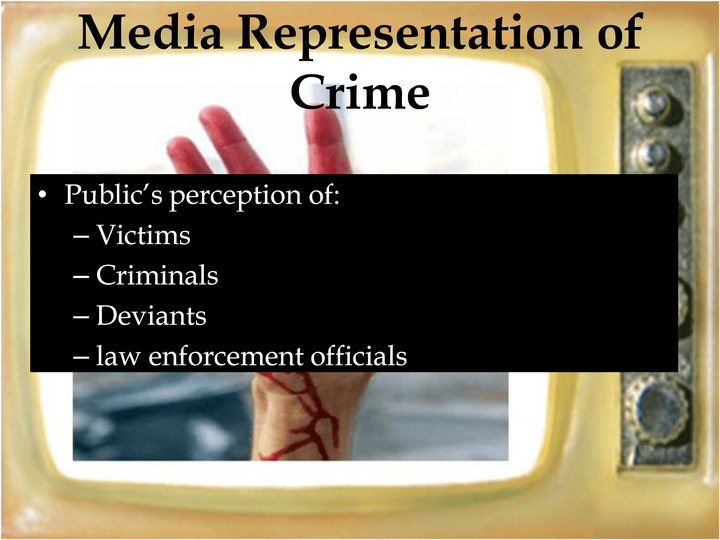
tend to impact how we see things related to crime. So, the research indicates that the majority of us don't have first-hand knowledge of the criminal justice system. And the majority of our knowledge about crime and justice, we get that from the media, and that shapes our perception of victims, criminals, deviances, law enforcement officials, etc.
This results in what has been termed the CSI effect.
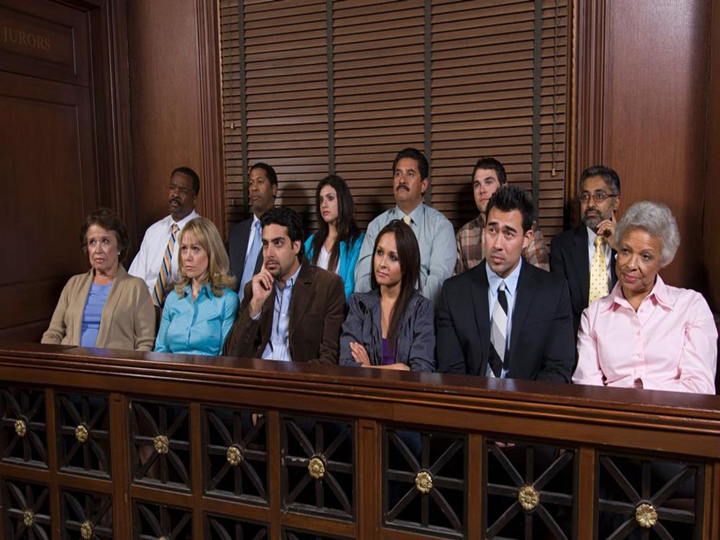
We're starting to see an effect that jurors tend to think that all cases are solved with DNA. And that's been traced back to the proliferation of crime shows that often
show crimes being solved with DNA. So, watching those TV shows can lead to unrealistic expectations regarding both crime and procedural justice. So, if a juror is sitting on a real-life case, and it doesn't have DNA, which very often they don't, those cases are often lost because of the public perception of how the case should look.
Juries made up of people who spend a lot of time watching crime dramas are more likely to find the defendant not guilty if no forensic evidence is presented at trial. That's a concern. If
the jury is made up of those who watch a lot of crime dramas, then
they're going to interpret evidence that isn't forensic--like non-DNA evidence--as too weak to warrant a conviction. That's kind of a concern.
The flipside of this is:
If you have a lot of jurors who watch crime dramas, and there's any kind of DNA evidence--even if it's not good DNA evidence or it's not really very accurate or something like that, So, even week forensic evidence--they're more likely to convict someone than someone who doesn't watch a lot of crime dramas. And that's concerning as well. If you are on trial for something you didn't do, and there's super weak forensic evidence, and you get a jury of folks who want a lot of crime dramas, they're probably going to find you guilty either way.
So, there's at least two views of
how media coverage works. First one we're going to talk about is the market model of media coverage. And this says that the media gives the public what they're interested in and what's in their best interest. The problem is sometimes what we're interested in and what's in our best interest aren't the same thing. They don't overlap.
And then there's also the manipulative model of media coverage of crime. This is a Marxist theory, which says media acts in the direct interest of its owner.
So, this theory points out that capitalist societies are maintained through coercion and consent. The dominant class controls the intellectual means of the production, i.e. the media, and they use the media to make us believe that the greatest threat to us, to our safety comes from the street criminall and then they do that to deflect our attention from their activities.
A lot of folks are interested in crime. I'm a crime hobbyist myself. A lot of folks who've known me long time were kind of surprised that when I got my PhD, I didn't study crime because I have had an avid interest in crime since very, very young. At least middle school, if not before. But I'm certainly not the only one. Lots of folks are really interested in cime. Why? Well, it's a complex psychological process. So, part of it is that
we feel better when we see other people feel better. So, we feel better about ourselves when we see other people are doing as well as we are. But we also feel better when we see people doing worse than we are. If you ever spent any time watching Jerry Springer, you may notice a little effect that: you don't even have to watch the whole show. You watch 10, 15 minutes to that, and you're like, "hey, I kind of thought maybe I was screwed up, but now that I'm watching this, you know, maybe I'm okay." So, that's part of it. You have the psychological process where we feel better about ourselves in relation to people worse off than us, which is really jacked up. But that's how we are. It also speaks to profound moral questions. It tells us the limits of human nature, and informs us about the moral Integrity of the community, and it binds us together. You think about when you're in public spaces, your waiting rooms, and things like that, and someone sparks up a conversation. It's not uncommon for someone to
remark on some case getting a lot of attention, and say, "how awful!" and you say. "how awful," and then you're having this like kind of bonding moment over you both having moral indignation about the terrible thing that has happened. You're reaffirming the norms and values of the society that you're in.
Media can actually influence criminal justice policy by focusing attention on specific issues. We're going to talk more about that later. It can determine what policy alternatives are given serious consideration. Media can also
be used by policy entrepreneurs to further their personal interests. So it can direct attention and actually impact change.
A lot of folks have pointed out the media puts forth a lot of fallacies about crime.
These are not all of them. These are some of them. So, there's an age fallacy. Media gives us the impression that all ages are involved in crime equally. That's not really accurate. There's a dramatic fallacy because the media focuses on violent crimes, and that generates fear among women and the elderly. The ingenuity fallacy: media gives us the impression that criminals are terribly clever, but the reality is that most crime is actually opportunistic. Someone happens on a open window or something like that. There's a class fallacy: media gives us the impression that the middle class are the most involved in crime as victims. That's not true, at all. You should probably have seen in your reading that the folks most involved in crime as victims are lower class folks.
A police fallacy: the media gives us the impression that the police are entirely more effective than they are. And that sounds like I'm throwing shade. I'm not. So, when you watch crime shows, you kind of get the impression that all the cases get solved, and in kind of in a timely manner. But that's not the reality of actual police work. Actual police work involves a ton of cases where they're just really isn't anything to go on, right? There's no DNA evidence. There's no there's no real evidence at all to tell them who is doing something. Okay, so, I'll give you an example.
It hasn't happened in a while, but when we first moved here every like 3 or 6 months, there'd be a rash of car break-ins in the neighborhood. Just folks getting into cars on folks' driveways and and just taking whatever they can find out the car.
And you always call the police and report it. Well, what
do they have to go on? Apparently none of us have cameras outside our house, Or apparently those who have cameras outside their hours, they don't break into their cars. So, you know, there's no video footage. There's no DNA left there. Just really no leads whatsoever for them to have any idea who did that. Let's say, at some point, they were driving through the neighborhood and they caught somebody breaking into a car. Well, that's great. But that doesn't tell them if that's the same person who broke into cars, you know, three months prior, or the night prior or whatever. They get a lot of cases that are actually difficult, if not impossible to solve--not like on TV. Okay, and you're like, "Well, that's a car break-ins and we don't have a lot of shows about car break-ins," and you're right. But even with murderers:
There's a lot of cases that just don't provide adequate clues for folks to solve it. So, that's not that's not shade at all. It's just the fact that if you watch a lot of crime shows, you could easily get the impression that policework might even be easier than it is because there's always all of this evidence for them to follow and figure things out, but that's not actually how it works in the real world.