Sign in to ask, answer and view questions.


Hi everyone it's me Sara Humphreys your course coordinator for ATWP 135 academic reading and writing and this is part 1 of the research workshops you need to complete your assignments and of course gain the skills you need to be successful in all your other courses I mean this is why we the 80 WP academic and technical writing program except to help you and all your other courses and I'll give you the skills you need so you can be successful what it whatever successful means to you right so also maybe we can also help you when you leave University and start your first professional position what I'm trying to say is that we are going to give you tools that you can take with you in your toolbox and use when you need.
I think that's pretty cool.
I'd like to introduce you to a method to test any Source you find when researching it's called the method craap and the point of this method is to remind you to ask questions about currency, relevance, Authority, accuracy, and purpose (or CRAAP) but whenever you research in other words were asking you to discern or trying to give you a way to understand when you are looking at "crap" or something that's not reliable and when you're looking at something that is reliable.
Your source needs to be current and needs to have relevance it needs to have authority, accuracy, and it needs to be relevan and have a purpose.
Can we talk about research for a second?
Because I often think that students might be a little confused or overwhelmed by this word when they get into University.
It's a word you see everywhere am I right?!
but maybe what you don't know is that you I bet you do anyways conduct research daily or at least weekly do you look up a recipe or had to do something maybe you need directions or your friend told you about some event you looked it up at the key here is you looked it up and when you do that (when you look something up on your phone when you go on your tablet or computer) guess what?
You're doing research.
So what separates research when you're kind of doing it on your own to find a recipe or whatever that might be and when you're doing it at University well I think reliability is key at the University level.
Our research needs to be reliable whether you're an undergrad or a full professor your research needs to be high quality and verified by experts in the field so that's really what separates University Research from the research you do when you're just looking up something that you know you might want to eat tonight I'm so the crap method then is a series of questions that you really do need to ask if any Source you might find and once you learn the method this can become second nature or habit and then you know when a source is unreliable and you know or if it's a source you can use meeting it's reliable and this is an invaluable School skill in University and out in the workforce and I cuz I really can't think of her profession where you don't have to perform some kind of research so let's get started shall we
now what I'm going to do is walk you through some of these questions and this won't take more than a few minutes so please get these slides available and refer back when you're doing research in this course and in your other courses too.
I hope you do find this useful and I do have to thank a librarian at the University of Waterloo that I used to work with Rebecca Hutchison who introduced me to this method.
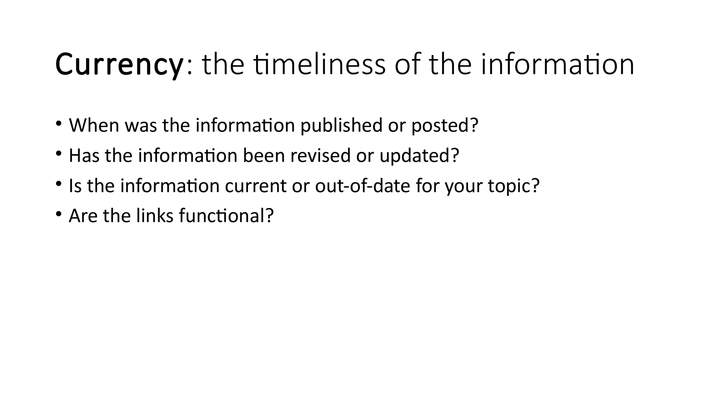
You need to look up when the information was published or posted has it been revised or updated and that means you are checking for Currency.
For example if you're on a website -- is the information current?
This may be very important, especially if you're in social sciences or Sciences.
Currency of information is incredibly important.
I'm going to show you how to check for this when we get to looking at how to use Summon which is one of our Fantastic Tools at tUniversity of Victoria libraries.
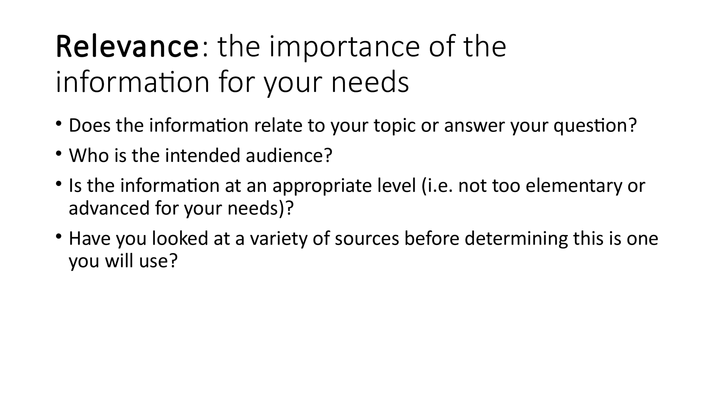
so relevant information -- you really have to have a clear idea of what your topic is or what you're researching about so before you start using the CRAAP method, you need to have a research area.
You don't have to have a thesis narrowed down necessarily, but you do really do need to know the research area, for example: "am I researching biodiversity in a mollusks?
" "am I researching race relations?
" "am I researching about a very specific topic like Tchaikovsky Symphonies" -- so that gives you a better idea of your purpose for researching and you need to understand whether something is relevant then you can ask questions of the information you are finding.
You always have to think about audience - audience context purpose - so important for whatever you're doing.
Whether you're writing;
whether you're researching: its audience context purpose.
Is the information at an appropriate level;
for example, if it's for K to 12 or kindergarten to grade 12, it might not be sophisticated enough for what you need.
Or it might be too sophisticated.
You really do need to take a look at whether it's to Elementary or to Advanced.
You need to have an array of resources so that you can determine whether you this is the resource you want to use.
That really means taking notes and keeping track of what you've looked up and that's where the annotated bibliography assignment for this course is going to be really important for you.
That's one of the places where you're going to collect resources and I strongly suggest you use the method of annotating your sources and collecting them for your courses where you have to conduct research.
Such note taking doesn't have to be as formal as an annotated bibliography but you should keep track of your sources and that's why the annotated bibliography assignment is so crucial and teaching you that particular skill of keeping track of your sources and accurately identifying them.
That's really important at the University level and really for any kind of research to Let's Move Along
Authority, my goodness, this is really important to know if a source is reliable.
You have to know who authored it.
In peer-reviewed Articles that's the biography of the author that really short one basically their name and their affiliation and usually you can tell what degree level they're at and most the time most the time not all the time he reviewed articles are published by those who have doctorates and also they have their name will be the doctor X and Y.
You know I do have that title Dr.
Sara Humphreys and that tells you I have a PhD and that means I've gone through the process of understanding what is an accurate Source how to use sources and how to write about them but guess what?
Somebody who has a master's degree also has that skill level as well but they won't have the doctor in front of their name but they have that skill.
Yes, you should look up whether the author's credentials are valid.
If you have time, it's always a good idea to look up the authors of an article I think it'll only sleep it would honestly take you 20 seconds just plug their name and their you know honorifics that you know if there are doctor or not or order affiliation if they don't have that title into into any kind of URL so if you're using being or intended URL into any toolbar and what you would want to do that is look up who they are and then you can read about their qualifications.
If you find them but the site looks dubious so it's not that they aren't Affiliated to any University but they're calling themselves doctor so-and-so but there's no webpage for their university and maybe their spelling mistakes in that web page I think the authority of that Source has ticked way down but if you're not using a peer-reviewed article, you should also look up the author's qualifications to write about that topic and it again if it seems really shaky or dubious I just wouldn't use it
.
Edu sites they're probably your best bet you know again if you use the crap method you can discern if a source is useful or even better you can ask a librarian ask a librarian I'll say it again Ask a librarian you can contact them very simply that information is available on the research anywhere site which is linked on our core spaces site so let's move on
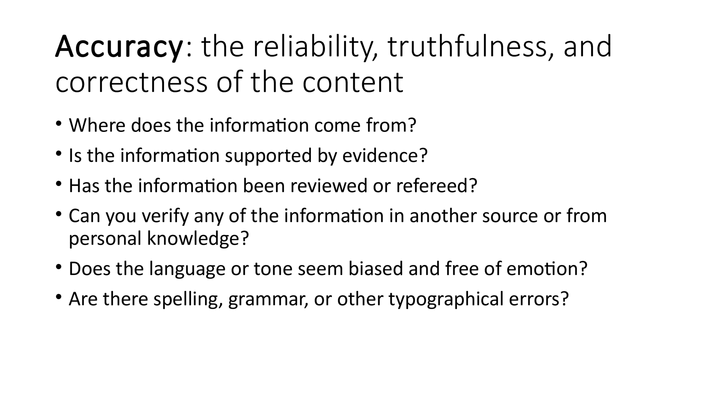
accuracy is absolutely as important as reliability truthfulness and correctness so you want to look up where the information came from.
If you have time it's good to see if there's any other articles about that particular data set where is the information supported by evidence to are there citations or is this just all opinion by the author some sources are all opinion and then they are not overly reliable that might be a good source if you were looking up how to make dinner or if you were looking up you know a movie review but that's not good enough for University level research.
Remember everything needs to be reliable;
it needs to be documented;
it needs to be supported.
Again, if you see those type of graphical errors spelling or grammar errors I don't think you should use that Source okay.
If you have any questions about us or what you going to do you can ask a librarian.
You can ask your professor but Librarians are fantastic and they are there to help you...
okay, let's move on
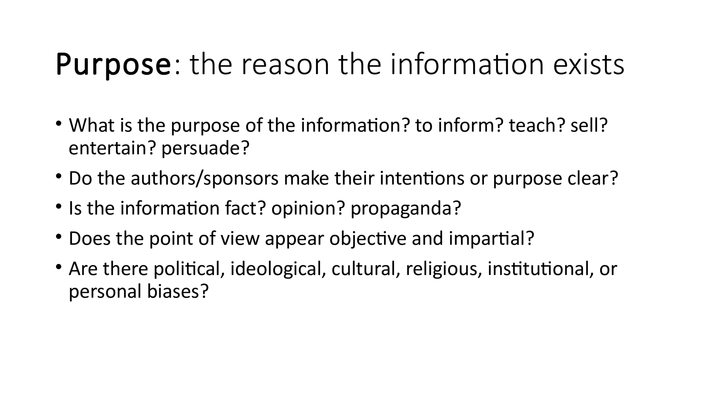
so you have a purpose for researching and you know that purpose you're looking for information that's relevant to your your purpose, but then you need to think about the purpose of the source you're looking at and so you need to ask yourself: is that Source trying to sell you something.
Yes, that can happen especially when you're online.
I have had you know I have had students hand in work that seem so very reliable for example if you are researching about something about pipelines, which is a huge debate in Canada right now, and you find information from the David Suzuki society and that's online and then you also find information from you know Westerners for the Oil Patch or something like that (I'm just making these things up) and the David Suzuki site it seems okay I mean have they made their intentions or purpose clear.
The David Suzuki site might be saying that their purpose is to follow the key principles of environmentalism so they are there to protect the environment whereas in Westerners for the Oil Patch is about promoting the oil patch and so what you're getting from both of these sites is actually opinion and it may be supported by some fact but they both have a bias toward certain belief systems (ideologies).
If you used both sources and then a few other sources, you may be able to get some kind of impartial view but you need to understand the reason why the information exists.
If you were just to use one source like the Suzuki source in your pipeline paper that is just it's just not good enough and your grades going to be lower because, again, University Research depends on reliability and so you need to know the purpose or the reason the intentions for of that particular source.
I hope that this is fairly clear for you and that when you go on to do your research that you will use it the CRAAP method.
I want to thank you for listening to me and I hope you enjoy this recording